Elwyn Berlekamp is one of the authors of the classic Winning Ways for your Mathematical Plays. One of these days I need to open up a substantial thread on Winning Ways. In the meantime, here's a cool video from Dr. Berlekamp.
How to always win at Dots and Boxes - Numberphile
https://en.wikipedia.org/wiki/Elwyn_Berlekamp
Friday, March 11, 2016

Thursday, March 10, 2016
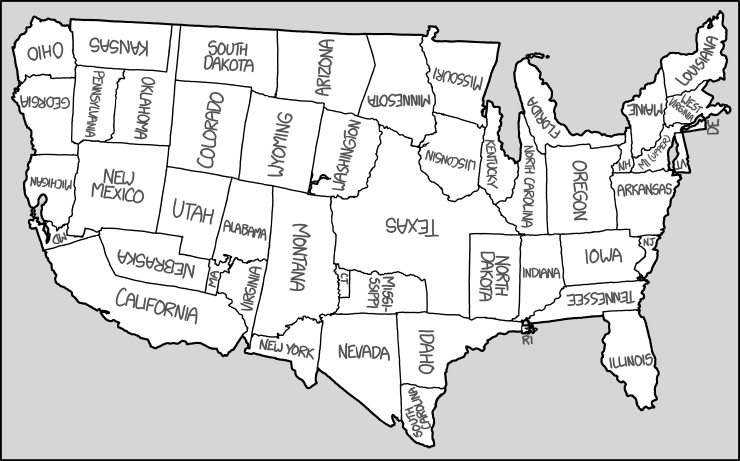
A different kind of name-the-states map
The cartoonist who created this explicitly say that it would be unfair to erase the names and use it as a name-the-states quiz, but I think it would make a great activity for small groups.

Wednesday, March 9, 2016
Short version -- policies that stress small children to the point where they throw up are probably bad policies
I am generally nervous about quoting overly partisan news sources. Even when the arguments are compelling, I am uncomfortable with discovery processes that seem to start with the conclusion.
That said, the Nation is a good magazine with a solid history of investigative journalism behind it. So, with the caveat that a publication this liberal will probably be hostile to charter schools (something we probably couldn't have said 10 years ago), this article is definitely worth checking out for anyone who's been following the debate.
In particular, this caught my eye:
Many of these techniques are remarkably hard on kids. Even if there were no other issues and the methods were accomplishing everything their supporters claimed, we would need to have a serious discussion as to whether or not they were worth the physical and emotional toll they are taking.
But there is considerable reason to question those alleged accomplishments. For starters, a lot of students do not make it all the way through the program. These kids pay a double toll, dealing with the stress not only of the no-excuses program but also of the disruption of being pulled out of one school where they have made friends and established relationships and put into another school where they are surrounded by strangers. Even for those kids who make it through, there is considerable evidence that the improvement in test scores is largely limited to one exam and does not translate into the areas we are really interested in.
That said, the Nation is a good magazine with a solid history of investigative journalism behind it. So, with the caveat that a publication this liberal will probably be hostile to charter schools (something we probably couldn't have said 10 years ago), this article is definitely worth checking out for anyone who's been following the debate.
In particular, this caught my eye:
Brenda Shufelt, a recently retired library who served public school and Success Academy Charter School students at a co-located school library in Harlem, noted that as charter schools rapidly expand, they may be taking in more high needs kids, many of whom cannot conform to one-size-fits-all disciplinary approaches.I realize that we have been hammering away at this thread for quite a while and I apologize for going over familiar ground in the next few paragraphs. Feel free to skim if you're a regular reader, but the following points do need to be emphasized.
“In my experience what would often happen is that charter school students would be so rigidly controlled that the kids would periodically blow up,” says Shufelt. “At PS 30, some of our kids would have meltdowns, usually because of problems at home, but I never saw kids meltdown in the way they did in charter schools. They were just so despairing, feeling like they could not do this. I was told by two custodians, they had never had so much vomit to clean up from kindergarten and elementary classes.”
Many of these techniques are remarkably hard on kids. Even if there were no other issues and the methods were accomplishing everything their supporters claimed, we would need to have a serious discussion as to whether or not they were worth the physical and emotional toll they are taking.
But there is considerable reason to question those alleged accomplishments. For starters, a lot of students do not make it all the way through the program. These kids pay a double toll, dealing with the stress not only of the no-excuses program but also of the disruption of being pulled out of one school where they have made friends and established relationships and put into another school where they are surrounded by strangers. Even for those kids who make it through, there is considerable evidence that the improvement in test scores is largely limited to one exam and does not translate into the areas we are really interested in.
Using Wikipedia critically
[via Popular Mechanics]
One of the things I've noticed since I started working with after-school programs a couple of years ago is that while students now spend a great deal of their time online, few are fully aware of the resources that could be making their academic lives so much simpler. I can't count the number of times I've seen students reading and rereading class notes hoping to find an answer that was just a few seconds away on Google.
Of these resources, perhaps the most underutilized is Wikipedia. It's not perfect, of course, but between breadth and surprisingly good quality control, there's nothing better on the internet for general factual questions.
Occasionally, though, something godawful does slip through.
Case in point...

We could, of course, dismiss this as being simply incredible, but simply dismissing the unbelievable is a potentially dangerous habit. Unlikely things do happen. Instead, the article strikes me as a great opportunity for discussing why we reject certain sources as unreliable.
1. Check the issues box.
Lots of red flags here.

2. Check the sources
Or, in this case, source.
"Forgotten Genius". Bobgrove.org. Retrieved 2015-07-28.
It's a brief post that cites no sources other than an alluded-to acquaintance with the subject, nor is there anything in the writer's online biography that suggests special knowledge.
3. Check the relevant pages
Go to the Wikipedia listings for the Manhattan Project and the Organic Rankine Cycle Engine and do a search for "Minto." You can probably guess what happens.
As far as I can tell, the only other place Minto does show up in Wikipedia is the also suspect entry on the Minto wheel, a cute but not very practical heat engine that seems to predate Minto by quite a bit.
One of the things I've noticed since I started working with after-school programs a couple of years ago is that while students now spend a great deal of their time online, few are fully aware of the resources that could be making their academic lives so much simpler. I can't count the number of times I've seen students reading and rereading class notes hoping to find an answer that was just a few seconds away on Google.
Of these resources, perhaps the most underutilized is Wikipedia. It's not perfect, of course, but between breadth and surprisingly good quality control, there's nothing better on the internet for general factual questions.
Occasionally, though, something godawful does slip through.
Case in point...

Wallace L. Minto (August 6, 1921, in Jersey City, New Jersey, United States – September 3, 1983) had a passion for science at a very young age. For instance, at age 13, he and his father, Wallace Milton Minto, stock piled more than 50 tons of uranium rich ore in Sparta, NJ. He was also the first to split the uranium atom while still a teenager. This nearly created an atomic explosion in his family home. At age 16, Wallace synthesized radium and invented what is now known as "Scotchlite". He had a copyright on his own periodic chart which renamed all the elements.
When only 16, he was a student at Columbia College and was later instrumental in convincing Albert Einstein to write a letter to President Franklin D. Roosevelt (dated August 2, 1939) stressing the need for the United States to expand its experimentation with Atomic Energy, leading to the Manhattan Project. Consequently, Minto sold his uranium rich ore to the U.S. Government for use in the Manhattan Project.[1]
On June 26, 1944, Minto was enlisted by Dr. Andrew H. Dowdy, director of the Manhattan Department of the University of Rochester, to take charge of the Special Problems Division of the Manhattan Project. Minto reported directly to General Leslie Groves and reportedly threw Groves out of his lab for tampering with his beakers.
We could, of course, dismiss this as being simply incredible, but simply dismissing the unbelievable is a potentially dangerous habit. Unlikely things do happen. Instead, the article strikes me as a great opportunity for discussing why we reject certain sources as unreliable.
1. Check the issues box.
Lots of red flags here.

This article needs additional citations for verification. (July 2015)That first one leads us directly to...
This article may be in need of reorganization to comply with Wikipedia's layout guidelines. (July 2015)
This article is an orphan, as no other articles link to it. Please introduce links to this page from related articles; try the Find link tool for suggestions. (December 2015)
2. Check the sources
Or, in this case, source.
"Forgotten Genius". Bobgrove.org. Retrieved 2015-07-28.
It's a brief post that cites no sources other than an alluded-to acquaintance with the subject, nor is there anything in the writer's online biography that suggests special knowledge.
3. Check the relevant pages
Go to the Wikipedia listings for the Manhattan Project and the Organic Rankine Cycle Engine and do a search for "Minto." You can probably guess what happens.
As far as I can tell, the only other place Minto does show up in Wikipedia is the also suspect entry on the Minto wheel, a cute but not very practical heat engine that seems to predate Minto by quite a bit.
Tuesday, March 8, 2016
Monday, March 7, 2016
Thinking about "teaching to the test"
[warning -- I dictated this to my phone so beware of homonyms.]
The following is probably both obvious and overly simplistic, but (putting aside emotional development for the moment) the primary purpose of instruction should be to increase students' mastery of the material (both knowledge and process based) while the primary purpose of tests is to measure that mastery. Those definitions are ridiculously broad but they'll serve for the moment, as will the rule of thumb that any instructional practice that doesn't improve mastery of the material or validity of the test should be viewed with suspicion.
I should also note before going any further that it has been many years since I got my teaching certificate and I have long since forgotten what little terminology I once knew. For the next few paragraphs I'll just be coining my own.
Teaching to the test – inclusive vs. exclusive
Inclusive teaching to the test – – making sure to cover everything students will be tested on – – is always defensible and is generally a very good idea.
Exclusive teaching to the test – – leaving out material you would otherwise cover because it is not going to be tested over – – is much more of a gray area. Obviously, teachers have to prioritize, but this should, at the very least, give one pause. In most cases, the test should include only a proper subset of the material covered.
Meta-Issues
Teaching to the meta-test -- prepping kids on the non-content aspects of the test -- gets even more gray. On a very high level it is certainly justifiable. You wouldn't want to have kids encountering strange formats and confusing instructions for the first time when they sit down to take a major test. On the other hand, this is an example of instruction that doesn't improve mastery of the material. If done for certain groups of students and not others, it runs creating an unfair advantage and thus undermining the validity of the test, which leads directly to...
Changing the conditions of the test
In order to get the most valid results, it would be best if all kids took all tests under optimal conditions -- motivated, well rested, comfortable, relaxed and free from distraction. We would always like to be sure that a low score represented a low mastery rather than a poor night's sleep. If, however, we can't be universally optimal, it is important that the suboptimal be distributed as uniformly as possible.
Teaching the actual test
Everything we've covered up to this point has ranged from OK to borderline, but ethical and even legal lines are quickly crossed when specifics of the test start making it into the prep materials available to only certain students. When individual teachers and administrators do this, they lose their jobs. When the companies that make the tests do it by selling "aligned" texts and prep materials, their stock goes up.
If you've been following the no-excuses discussion, lots of these concepts should sound familiar.
The following is probably both obvious and overly simplistic, but (putting aside emotional development for the moment) the primary purpose of instruction should be to increase students' mastery of the material (both knowledge and process based) while the primary purpose of tests is to measure that mastery. Those definitions are ridiculously broad but they'll serve for the moment, as will the rule of thumb that any instructional practice that doesn't improve mastery of the material or validity of the test should be viewed with suspicion.
I should also note before going any further that it has been many years since I got my teaching certificate and I have long since forgotten what little terminology I once knew. For the next few paragraphs I'll just be coining my own.
Teaching to the test – inclusive vs. exclusive
Inclusive teaching to the test – – making sure to cover everything students will be tested on – – is always defensible and is generally a very good idea.
Exclusive teaching to the test – – leaving out material you would otherwise cover because it is not going to be tested over – – is much more of a gray area. Obviously, teachers have to prioritize, but this should, at the very least, give one pause. In most cases, the test should include only a proper subset of the material covered.
Meta-Issues
Teaching to the meta-test -- prepping kids on the non-content aspects of the test -- gets even more gray. On a very high level it is certainly justifiable. You wouldn't want to have kids encountering strange formats and confusing instructions for the first time when they sit down to take a major test. On the other hand, this is an example of instruction that doesn't improve mastery of the material. If done for certain groups of students and not others, it runs creating an unfair advantage and thus undermining the validity of the test, which leads directly to...
Changing the conditions of the test
In order to get the most valid results, it would be best if all kids took all tests under optimal conditions -- motivated, well rested, comfortable, relaxed and free from distraction. We would always like to be sure that a low score represented a low mastery rather than a poor night's sleep. If, however, we can't be universally optimal, it is important that the suboptimal be distributed as uniformly as possible.
Teaching the actual test
Everything we've covered up to this point has ranged from OK to borderline, but ethical and even legal lines are quickly crossed when specifics of the test start making it into the prep materials available to only certain students. When individual teachers and administrators do this, they lose their jobs. When the companies that make the tests do it by selling "aligned" texts and prep materials, their stock goes up.
If you've been following the no-excuses discussion, lots of these concepts should sound familiar.
Tuesday, March 1, 2016
A working rotary engine made entirely of paper
Just because I haven't posted a cool video for a while.
Subscribe to:
Posts (Atom)