Monday, December 30, 2013

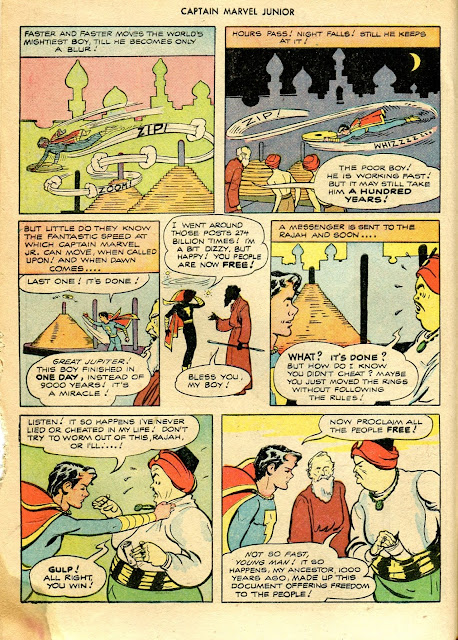
A Golden Age Comic Book introduction to Recursion -- The Pyramid of Eternity

From 1947. this Captain Marvel Jr. story has a surprisingly mathematical bent.


And a little later...


and a bit later still...


"The Pyramid of Eternity" is better known as the Towers of Hanoi and it's often used as example of recursion, particularly in programming courses. Here's the Wikipedia explanation:
A key to solving this puzzle is to recognize that it can be solved by breaking the problem down into a collection of smaller problems and further breaking those problems down into even smaller problems until a solution is reached. For example:
  • label the pegs A, B, C — these labels may move at different steps
  • let n be the total number of discs
  • number the discs from 1 (smallest, topmost) to n (largest, bottommost)
To move n discs from peg A to peg C:
  1. move n−1 discs from A to B. This leaves disc n alone on peg A
  1. move disc n from A to C
  1. move n−1 discs from B to C so they sit on disc n
The above is a recursive algorithm: to carry out steps 1 and 3, apply the same algorithm again for n−1. The entire procedure is a finite number of steps, since at some point the algorithm will be required for n = 1. This step, moving a single disc from peg A to peg B, is trivial.

Sunday, December 29, 2013

Puzzle ideas for K through 2 -- odd and even

From Suzie Comics, 1954

These basic formats would be fairly easy to apply to other properties of numbers such as being prime or divisibility by, say, three.


Saturday, December 28, 2013

Talking about the How to Solve It list -- part 1

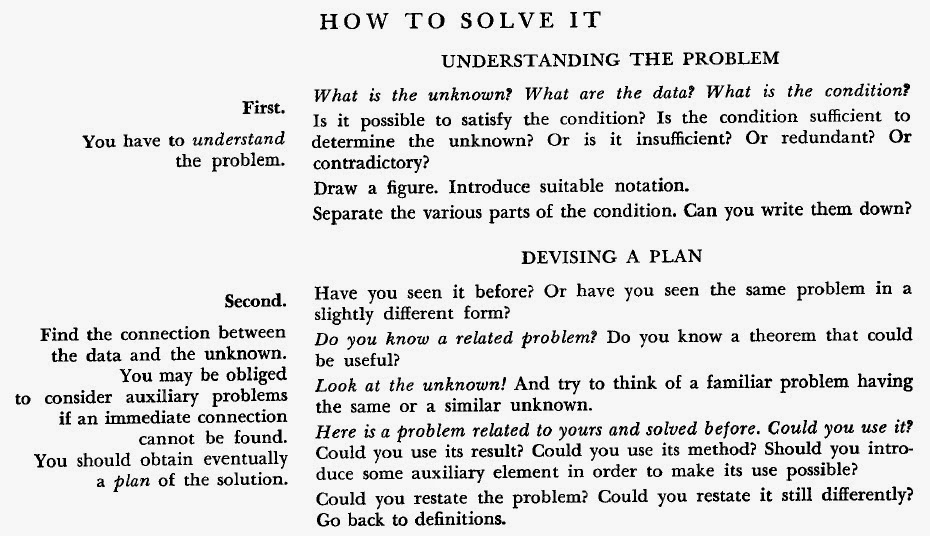
How to Solve It starts with what you might call a summary. It covers two pages (printed sideways to form one large sheet) and it is, by far, the best known part of the book. This is both a good and a bad thing. On the good side, the sheet contains an extraordinary amount of useful ideas; on the bad side, the teachers who explain it often know little about Pólya's philosophy and treat the list as a kind of an algorithm for general problem solving.

Pólya disliked cookbook approaches and he believed that the search for a generalized approach to problem solving, while interesting and likely to yield useful insights, was a doomed effort. He certainly didn't mean for this list to be treated as an algorithm to be checked through. Here's how he puts it in the introduction:


Put another way, this is a list of things you can try when you're having difficulty solving a problem. They have an excellent track record over a wide range of situations and difficulty levels but they have to be applied with common sense in context and, even when used appropriately, they are meant to help you think through a problem, not to do your thinking for you.


Monday, December 16, 2013

Polya -- found in translation

Whenever my students complained about word problems, my standard response was "life is word problems. No boss is ever going to walk up and ask you to solve this quadratic equation." I've logged a lot of cubicle hours since then and the observation still holds.

As for the actual mechanics of actually translating prose into algebraic expressions, you will find few explanations better than this one from George Polya's How To Solve It. Pay particular attention to the distinction between word-for-word translation and idiomatic translation.


Sunday, December 15, 2013

One very limited argument against learning your multiplication tables

When I was in elementary school, I refused to learn my multiplication tables. I detested rote memorization and memorizing answers struck me as cheating (after all, you were still looking up answers;  you were just doing it in advance). Fortunately, (though it may not have seen that way if the time) I was at and unstructured school that allowed students a great deal of freedom.

The immediate result was that I became very slow at doing math assignments. I had always been moderately slow doing worksheets. Teachers had commented earlier to my parents that though all the questions attempted were usually correct, I seldom finished my assignments. When multiplication entered the picture, my pace became glacial.

After a while, though, I started to pick up some tricks that helped greatly. Since doubling a number in my head was easy and tripling wasn't too bad,

I soon started factoring multipliers where possible and then multiplying by the factors. Thus four became double double and six became triple double. Since five and 10 were also easy to multiply by, that covered everything but seven. For seven and for larger numbers, I often relied on the distributive property though I had no idea that's what I was doing. 11 Times a number is the same as 10 times a number plus the original number. 19 times a number is equal to 20 times the number minus the original number.

This created an entirely new "problem" or at least extra step when I did my math homework. Whenever I had to multiply two numbers together I had to decide which forms of the numbers to use. Eight could be 2×2×2 or 4×2 or 2×4. Nine could be 3×3 or 10-1. Some forms made the problems easier than others but, amazingly, no matter which form I used the answer was always the same.

In the short term, my self imposed pedagogical experiment could not be called the success. My work was slow and my test performance dropped. Fortunately I had supportive parents and exceptionally understanding and flexible teachers and administrators.

I say "fortunately" because in the end things did work out well. The turnaround started with fractions. Ideas like simplifying and finding the lowest common denominators came naturally because of the groundwork that had been laid earlier. With algebra, the effect was even more pronounced.

This was partially because of the specific concepts I had been using, but the more important factor was the general approach to problem solving which I have been forced to take. Questions that would have been trivial had I done what I was told to do, instead required a great deal of thought. I had to think about all the different ways I could find to state the problem, then I had to decide which approach would be the easiest and quickest. In the long run, it turned out that this method was a pretty good way of approaching most mathematics.

Just to be clear, I am not saying that we should stop teaching multiplication tables. I'm not even saying that I would not have been better off had I simply done what I was supposed to do.

Saturday, December 14, 2013

Polya's approach to anagrams

[You might want to check out the first two posts in the thread before going on]

George Polya uses a wide range of example in How To Solve It, ranging from some relatively advanced math problems to basic puzzles.

This example of the latter might make an interesting problem to do as a class. Here's how I'd set it up.

1. For the opening, you can pretty much just stick with what Polya has here.

2. Then have the class come up with words using at least some of the letters in the anagram.

3. You'll probably end up with relatively few words using X (and maybe Y). If so, suggest that since words with X (or X and Y) are fairly rare, it might be a good idea to list all of these the class can think of. Note that Polya gave the similar advice.

4. If the class comes up with the word EXTRA then loses steam, you might ask if there are any words that start with EXTRA.

5. If you run out of time and hints and if you can call up the internet, "when I Googled 'anagram solver' this is what I got" and go here. Remind them that finding an answer online or in a book is yet another problem solving strategy.