A blog of tips and recommendations for anyone interested in learning or teaching mathematics.
Showing posts with label paper. Show all posts
Sunday, May 5, 2013
Sunday, April 7, 2013
Make your own Platonic Solids -- let the conspiracy theories commence
(Via Google, I found these at the Philalethes Society site, so active members of the Anti-Masonic Party might want to skip to the next post)
Here's another chapter in the ongoing playing with paper series. There are any number of interesting lessons you can build around the five Platonic Solids (as usual, Martin Gardner has some clever suggestions), but the best place to start is probably by building intuition by letting the kids make and manipulate them.
Depending on the age and sophistication level of the class, try one or more of the following:
1. Decorate then assemble these patterns;
2. Use these patterns to make dice. Try playing familiar games (chutes and ladders, Parcheesi, etc.) with the new dice;
3. Make mobiles using Platonic solids and paper tubes;
4. Make sculptures with the condition that attached sides have to match (this gives you three types of sculptures -- cube-based, dodecahedron-based and everything else);
5. Measure the surface area of each solid;
5b. Use fine Styrofoam pellets to estimate and compare the volumes of the different solids.
6. Using clear plastic for the outer shell, create dual polyhedron.
Wednesday, April 3, 2013
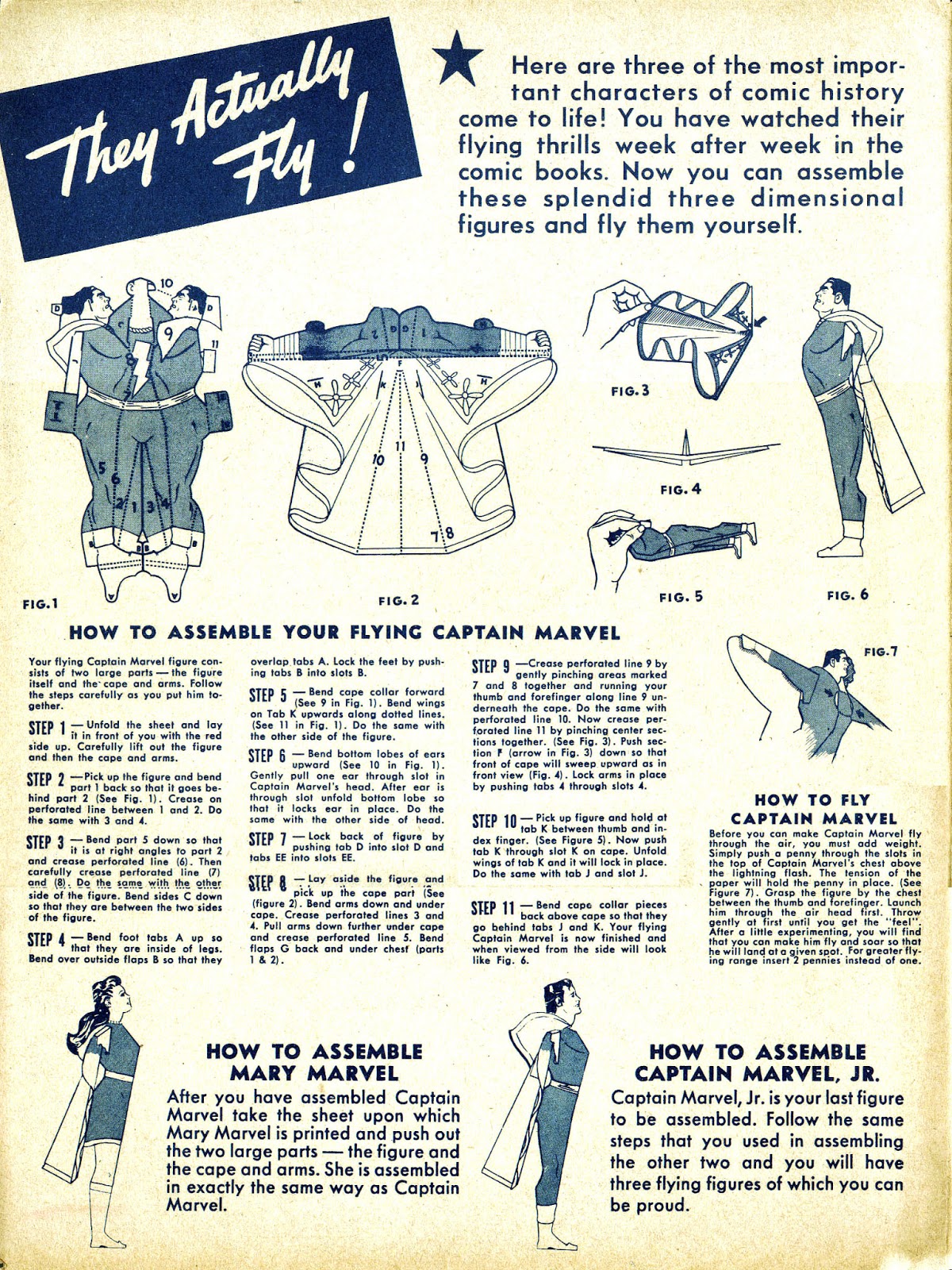
Captain Marvel paper airplanes from 1945
More in the ongoing series on paper-based manipulative and projects.
I came across these online and I have no idea how well they actually fly, but given that we're talking about paper airplanes in the shape of cartoon characters, they should be a fairly easy sell.
Here are some thoughts on how to build a lesson plan around these toys. (I'd use the heaviest paper your photocopier can handle).
Since these actually WWII era toys, there's an obvious opportunity for teaching across the curriculum.
Try a basic statistics exercise by doing multiple tests of all three, recording distance and glide time and plotting the results.
Have kids come up with their own designs along the basic lines of these planes but with different themes and characters.
Tie this in with other paper airplanes and models.
From Just a Pile of Old Comics
Tuesday, March 26, 2013
Saturday, March 16, 2013
Paper Models
The always fun Low Tech Magazine has a very cool post on the rediscovery of paper models. As mentioned before, paper can only be folded into a certain family of shapes, but modelers have found some clever ways around the limitations over the years.
These do it yourself paper toys used to be quite popular. Now they're making a comeback online. The Low Tech article links to a wide array of historical models (most of which also provide opportunities for teaching across the curriculum). You can download simple ones as individual activities...
Or bigger, more complex ones as group projects.
Friday, March 15, 2013
Paper Towers
As mentioned before, paper is a excellent medium for engineering projects because
1. It's cheap and cheap is good for experimentation
2. Paper has a number of interesting and useful properties from a material science standpoint
3. From a pedagogical standpoint, these properties take on extra value because the material is so exceptionally ordinary. We want students to get in the habit of looking for the interesting in uninteresting places.
My recent fascination with the subject started with this idea for a class project/competition:
The task: build a platform at least 6" tall to support a 1' by 1' board (or piece of cardboard) and some weights that will be placed on it. (best of three tries).
Materials: 20 sheets of standard typing paper and 20 1" pieces of Scotch tape.
Objective: to support the most weight possible
In addition to the previously mentioned benefits of using paper for manipulatives, this project has a few other big selling points.
The students will probably be surprised at how strong an arrangement of paper tubes and cones can be and this surprise might help feed their curiosity.
The project is largely open-ended yet it has a well-defined metric of success. The better tower is the one that supports the most weight. There's little question about whether one design is better than another.
The project can employ some surprisingly sophisticated engineering.
The project can be used, with little or no modification, for students ranging from fourth graders to first year engineering students. There is enough potential for discovery that a ten year old and a twenty year could both learn something from giving it a try.
Two variations to this project immediately suggest themselves.
First is to use a fixed weight (let's say five pounds) and make the winner the highest structure that can support the weight.
Second is to use some function of weight and height. I'll let you think about that one on your own.
Reseeing Paper
We don't talk about it as much as we should but one of the fundamental goals of education is cultivating alertness, producing students who notice and think about everything around them. One way of achieving this is to show kids new ways of looking at the ordinary.
There are few things more familiar and mundane than a blank sheet of paper, but from a material science standpoint, that paper has some cool properties. Paper doesn't like to stretch or compress. Normally that would make for an object that didn't like to bend. Bending usually entails stretching because the outside of a curve has more area than the inside due the thickness of the material being bent. A sheet of paper, though, is so thin that this difference is negligible. Think about a pipe; the circumference of the inside is noticeably less than that of the outside. Now think about a tube made by lining up opposite edges of a piece of paper. The circumference of the inside is less than that of the outside but the difference is very small.
This bend-but-not-stretch property means that paper can only be bent into a certain family of shapes. You can make a tube or a cone or even an extruded sine curve but you can't, for example, make a dome.
These properties of paper also make it a great medium for discussing the properties of shape. In sheet form, paper is almost synonymous with flimsy, but if you form a sheet of paper into a tube or a cone* it can support a surprising amount of weight. Sandwich the previously mentioned extruded sine curve between two other sheets and you get a very strong board relative to its weight. Add another layer with the extrusions at right angles and the performance is even more impressive.
Paper-based manipulatives and projects are a great way of teaching a number of concepts in geometry, physics and engineering. More importantly though, they make the point that the most unexceptional class of things imaginable is, in fact, pretty exceptional.
Here are some project ideas. If you like what you see check back because I'll be updating this post.
The Platform Contest
Old Time Paper Models
Paper Chains
Paper bridges
Subscribe to:
Posts (Atom)