A step-by-step solution to the classic alphametic.
These videos are still very much a work in progress but at least I'm seeing signs of that progress. Trying to do this in one shot and some parts are more confusing than they should be, but those mistakes can be learned from. I was more worried about getting the narration natural and conversational. and in that respect I feel things are definitely moving in the right direction.
I'll be experimenting with more puzzle videos in the future, though probably ones that require less than thirty slides to explain.
Showing posts with label math puzzles. Show all posts
Showing posts with label math puzzles. Show all posts
Tuesday, February 23, 2016

Wednesday, March 18, 2015


Monday, October 6, 2014
Classic Puzzles for a Monday
Given the quantity of Nugent's output, the quality was exceptionally good.
%2B059CLEANbrightdim660x900comp92.jpg)
From Classic Puzzles for the Classroom.
Saturday, September 20, 2014
Puzzling your way through the GRE -- logic edition
I was looking through a GRE sample test the other day and I came across a question that looked oddly familiar. I am not going to repeat it verbatim (not quite sure of the copyright status) but the gist was that the question gave some names and some properties associated with those names and some conditions.
After a moment, I realized that this problem reminded me of an old-fashioned logic grid puzzle.

Here's an example from a popular site:

You probably won't see a grid like this on the GRE or the SAT but you will run across the underlying concepts so if you're preparing for one of these tests, it might be worth your while to spend a little of your study time as play time with these puzzles.
After a moment, I realized that this problem reminded me of an old-fashioned logic grid puzzle.
Here's an example from a popular site:
You can eliminate pairs you know aren't true with an X, and pencil in pairs you know are related with an O. If you know, for example, that Lauren wasn't born in 1961, you can add an X in the box where the Lauren column and 1961 row meet. Similarly, if you know that Bryant was born in 1971, you can add an O in the appropriate box. Furthermore, since every option can only be used once in any given puzzle, you can eliminate the four other options for Bryant in that category (1937, 1946, 1961, 1975) and the four other options for 1971 (Anahi, Jayden, Lauren and Nikolas).

You probably won't see a grid like this on the GRE or the SAT but you will run across the underlying concepts so if you're preparing for one of these tests, it might be worth your while to spend a little of your study time as play time with these puzzles.
Friday, January 3, 2014
"100 COMICS AND GAMES – PUZZLES – MAGIC".
[I'm putting together an e-book collection of puzzles from Golden Age comics. This post is taken from the introduction.]
From Wikipedia's Famous Funnies article:
If you look at The cover of that first issue of famous funnies, you will See the subtitle "100 COMICS AND GAMES – PUZZLES – MAGIC".
.jpg)
The idea behind those early comics was simply to make cheap reprints of some of the most popular features of the daily newspapers. There was at least one major difference, while newspapers were seen primarily as an adult medium with some content thrown in for children, comic books were seen as primarily a kids medium.
This difference in target audiences was particularly notable when you look at the puzzle sections. In a newspaper or magazine of the time, these sections could be extremely demanding (such as the New York Times crossword puzzle) and even mathematically sophisticated. Starting in the late 19th century in magazines such as the Strand, creators like Sam Loyd, Henry Dudney, and, of course, Lewis Carroll were composing puzzles that often opened up areas of serious mathematical research.
You wouldn't find much in the way of cutting edge mathematics in the pages of famous funnies and other early comic books. These were puzzles intended for children. What's more they were cranked out at considerable speed and were usually fairly standard and often redundant.
Within those limitations, however, some creators really did manage to shine. Two in particular stand out, both as puzzlers and artists. The first was Art Nugent, a gifted cartoonist who produced a steady stream of charming and often quite clever puzzles for about a half a century. The second, though less prolific as A puzzlemaker, is sometimes considered one of the premier cartoonist and graphic artist of the 20th century, George Carlson.
Carlson was an extraordinarily successful commercial artist. Among other notable accomplishments, he painted the dust cover for the first addition of gone with the wind. As a comic book artist and writer, he created the highly influential jingle jangle comics which writer Harlan Ellison claims puts him in the company of artist such as Windsor McKay and George Herriman.

In terms of puzzles, Carlson was equally gifted. Martin Gardner said of Carlson's Peter Puzzlemaker series "no better collection of puzzles for young people was ever published."
From Wikipedia's Famous Funnies article:
That same year, Eastern Color salesperson Maxwell Gaines and sales manager Harry I. Wildenberg collaborated with Dell to publish the 36-page one-shot Famous Funnies: A Carnival of Comics,[4] considered by historians the first true American comic book; Goulart, for example, calls it "the cornerstone for one of the most lucrative branches of magazine publishing".[5] It was distributed through the Woolworth's department store chain, though it is unclear whether it was sold or given away; the cover (see left) displays no price, but Goulart refers, either metaphorically or literally, to Gaines "sticking a ten-cent pricetag [sic] on the comic books".[6]
When Delacorte declined to continue with Famous Funnies: A Carnival of Comics, Eastern Color on its own published Famous Funnies #1 (cover-dated July 1934), a 68-page periodical selling for 10¢. Distributed to newsstands by the mammoth American News Company, it proved a hit with readers during the cash-strapped Great Depression, selling 90 percent of its 200,000 print run; however, its costs left Eastern Color more than $4,000 in the red.[6] That quickly changed, with the book turning a $30,000 profit each issue starting with #12.[6] Famous Funnies would eventually run 218 issues, inspire imitators, and largely launch a new mass medium.
If you look at The cover of that first issue of famous funnies, you will See the subtitle "100 COMICS AND GAMES – PUZZLES – MAGIC".
.jpg)
The idea behind those early comics was simply to make cheap reprints of some of the most popular features of the daily newspapers. There was at least one major difference, while newspapers were seen primarily as an adult medium with some content thrown in for children, comic books were seen as primarily a kids medium.
This difference in target audiences was particularly notable when you look at the puzzle sections. In a newspaper or magazine of the time, these sections could be extremely demanding (such as the New York Times crossword puzzle) and even mathematically sophisticated. Starting in the late 19th century in magazines such as the Strand, creators like Sam Loyd, Henry Dudney, and, of course, Lewis Carroll were composing puzzles that often opened up areas of serious mathematical research.
You wouldn't find much in the way of cutting edge mathematics in the pages of famous funnies and other early comic books. These were puzzles intended for children. What's more they were cranked out at considerable speed and were usually fairly standard and often redundant.
Within those limitations, however, some creators really did manage to shine. Two in particular stand out, both as puzzlers and artists. The first was Art Nugent, a gifted cartoonist who produced a steady stream of charming and often quite clever puzzles for about a half a century. The second, though less prolific as A puzzlemaker, is sometimes considered one of the premier cartoonist and graphic artist of the 20th century, George Carlson.
Carlson was an extraordinarily successful commercial artist. Among other notable accomplishments, he painted the dust cover for the first addition of gone with the wind. As a comic book artist and writer, he created the highly influential jingle jangle comics which writer Harlan Ellison claims puts him in the company of artist such as Windsor McKay and George Herriman.

In terms of puzzles, Carlson was equally gifted. Martin Gardner said of Carlson's Peter Puzzlemaker series "no better collection of puzzles for young people was ever published."
Wednesday, October 30, 2013


+059.jpg)


Sunday, May 26, 2013


Sunday, April 14, 2013
Bookshelf -- The Hinged Square & Other Puzzles by Ivan Moscovich
I haven't seen the rest of the series but based on this book and Moscovitch's reputation, I'd certainly recommend seeking them out. The puzzles are beautifully illustrated and, in some cases, accompanied by a explanation of the underlying mathematics.
The book also features the extraordinary pencil and paper game racetrack.

The book also features the extraordinary pencil and paper game racetrack.

Sunday, February 24, 2013
Bookshelf -- Math Puzzles & Games by Michael Holt
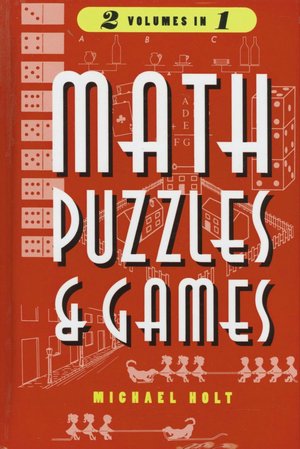
This is a nice little book. A good collection of puzzles concluding with an excellent set of games such as nine men's morris and tactix. It's also another example of the cheap but deserving books Barnes and Noble used to find and republish. They've shut down that division but it's still worth seeking the imprints out when you're in a used book store.
Wednesday, December 26, 2012
Above the line, below the line
Even in the tightest, most focused class, there will be some slack time. Maybe you don't have a quorum of students, or you're waiting to be called to an assembly, or you finished a lesson early or you just realized that the kids need a break.
Particularly for inexperienced teachers, slack time can present a real threat to classroom management. When not being challenged with mathematical concepts, those active young brains will quickly turn to the problem of finding clever and effective ways to test authority.
But slack time can also be an opportunity. In a relaxed setting, doing something that doesn't trigger their math-is-hard defenses, you can often sneak in some useful problem solving and pattern recognition practice. Even more importantly, you can reinforce the alertness essential to being good at math.
Which brings us to this family of puzzles.
Go up to the board (preferably without saying anything), draw a horizontal line, then start writing the sequence A, B, C... or 1, 2, 3..., putting some of the characters above the line and some below based on some property of the letters or digits. Somewhere in the middle of this you stop, turn to the class and ask where the next letter goes.
A B D ______________________________________________________________________________
C E F G
If you get the wrong answer, shake your head, write the character in the proper place then ask about the next. You may have to give a couple of hints but usually someone will let out an "Ooooh" of realization and will start eagerly shouting out the answers.
The property here is topological and you can, if you want, use this introduce topology or even to open a lesson on homotopy equivalence.

The important here though isn't introducing the topological terms; it's getting students to think topologically, to add these properties to the things they look for.
The properties in an above/below puzzle can be anything your students could reasonably be expected to spot, from prime vs. composite for numbers to the phonetic spelling of letter (there's a clever New Yorker cartoon that put the alphabet in alphabetical order but I can't find it on line).
Particularly for inexperienced teachers, slack time can present a real threat to classroom management. When not being challenged with mathematical concepts, those active young brains will quickly turn to the problem of finding clever and effective ways to test authority.
But slack time can also be an opportunity. In a relaxed setting, doing something that doesn't trigger their math-is-hard defenses, you can often sneak in some useful problem solving and pattern recognition practice. Even more importantly, you can reinforce the alertness essential to being good at math.
Which brings us to this family of puzzles.
Go up to the board (preferably without saying anything), draw a horizontal line, then start writing the sequence A, B, C... or 1, 2, 3..., putting some of the characters above the line and some below based on some property of the letters or digits. Somewhere in the middle of this you stop, turn to the class and ask where the next letter goes.
A B D ______________________________________________________________________________
C E F G
If you get the wrong answer, shake your head, write the character in the proper place then ask about the next. You may have to give a couple of hints but usually someone will let out an "Ooooh" of realization and will start eagerly shouting out the answers.
The property here is topological and you can, if you want, use this introduce topology or even to open a lesson on homotopy equivalence.

The important here though isn't introducing the topological terms; it's getting students to think topologically, to add these properties to the things they look for.
The properties in an above/below puzzle can be anything your students could reasonably be expected to spot, from prime vs. composite for numbers to the phonetic spelling of letter (there's a clever New Yorker cartoon that put the alphabet in alphabetical order but I can't find it on line).
Saturday, December 15, 2012
My favorite classroom puzzle

When I was teaching I would always keep some form of this grid around, either printed out on sheets of paper or in a PowerPoint or some other digital form. Whenever I had to keep a room full of students out of trouble I'd put this up on the screen or pass it out and ask them to count the squares, keeping in mind that a square could be one by one, two by two, all the way up to twelve by twelve.
Take a minute and give it a try. I'll wait...
I like this problem for a number of reasons. It's a problem that's extraordinarily difficult unless you hit upon the underlying pattern at which point it can be solved in about a minute. The insight does not require any background other than fifth grade math. The solution is simple and elegant and only relies on sixth grade math but it often eludes people with considerable mathematics background.
Like many problems this is easier if you pick the right side to start from. Most people will start with the one by ones by multiplying 12 by 12, then will move on to the two by twos. You're more likely to succeed if you start with the twelve by twelve then try the eleven by elevens (or better yet, start with the one by ones then jump to the the twelve by twelve then the eleven by elevens) then the ten by tens. Counting the bigger squares is simpler and the pattern will probably jump out quicker this way.
There is, of course, one twelve by twelve square in the picture, and it shouldn't be difficult to see that there are four eleven by elevens and nine ten by tens. So we want to find the sum of a sequence of twelve numbers that starts with one, four, nine and ends with one hundred and forty-four. Once you have the pattern in mind, you can start asking yourself why it holds. With a little thought you can probably get to this insight: for an n by n square, the bottom left corner has to fall in a square with sides twelve minus n plus one.
Like most good math puzzles, this is very Polya -- you use inductive reasoning to formulate a hypothesis then find a proof that shows the hypothesis must be true -- but that's a topic for a lot of future posts
Sunday, November 18, 2012
The Number-line Code

This one grew out of some time I spent recently helping a family first-grader with her subtraction homework. I made up some sheets with numbers and letters. My original thought was just to make the practice sheets more interesting by having the answer spell out a word, but I noticed my tutoree (who naturally has very good math genes) had, without prompting, started using the code key as a number line to figure out the answers.
The more I thought about it, the more I liked the idea of using this approach for a wide range of problems. For the very early grades, it teaches numbers and letters. It has great appeal for kids (particularly if presented with the right air of mystery -- I'd suggest a pirate motif). It reinforces the number line concept and the essential idea of looking things up in tables.
Here are some sample problems
For those learning to read, present it as a straightforward code:
PIRATES LOVE 7-15-12-4
For slightly more advanced students, replace the numbers with problems
PIRATES LOVE
10 - 3
10 + 5
6 + 6
6 - 2
For even more advanced students, make it a more explicit number line exercise
PIRATES LOVE
7
+8
-3
-8
You can even play with functions by using the old SAT trick of using a circle to represent x+1 and a triangle to represent x-1 (or any other functions you can think of).
triangle 8
circle 14
circle 11
triangle 5
I'd suggest using this technique frequently enough to keep the familiarity high. It also offers extensive opportunities for teaching across the curriculum.
Anyone have any other ideas?
Subscribe to:
Posts (Atom)