Showing posts with label math games. Show all posts

Sunday, June 9, 2013

Bookshelf: a pretty good little book on row games

I didn't actually have high hopes when I came across this in a library game section but I was pleasantly surprised. Lots of interesting variants and plenty of opportunities for introducing mathematical topics and teaching across the curriculum.


Tic Tac Toe: And Other Three-In-A Row Games from Ancient Egypt to the Modern Computer
by Claudia Zaslavsky

Sunday, June 2, 2013

Weekend Gaming -- that other chess set is just sitting there


Back at the turn of the millennium when I was wasting away in the suburban hell of [redacted], I found myself killing a lot of time at the Borders down the street. Most days there would be a old man sitting at one of the tables with two chess sets set up up side by side with the edges of the boards touching. At the side of the table was a hand lettered sign inviting people to try the new game, superchess.

I never had the heart to tell him that the game he invented had been around for decades. That's not to say chess with twice the pieces on an 8x16 board isn't a good idea. It's a simple but elegant variation on the game and since, unlike most fairy chess, almost all of the moves and rules are unchanged, it stays remarkably true to the original game.

You move your pieces just as you normally would, only over a board that's twice as wide. You can't castle but other than that the only difference is the objective. Here you have two choices. The more common seems to be where the winner is the first to capture both opposing kings but I prefer playing for first blood (first player to capture a king wins).

You can find a more detailed discussion here or you can just grab a couple of boards and jump right in. As a chess variant, it's not as interesting as hexagonal chess but it's still definitely worth a try.

Sunday, April 21, 2013

The greatest board game series ever?

I was never entirely clear on why 3M decided to get into the board game business, but for more than a dozen years they put out 3M's Bookshelf Games (so called because the boxes were designed to look like large hardcover books when placed in their slip covers). The line-up was a mixture of traditional games like chess and go and new games designed by freelancers like the incomparable Sid Sackson (Sackson's classic Acquire was a 3M game). The weakest of the series were still pretty good while the best have become, as mentioned before, classics.

Software developer Dennis Matheson has a detailed and affectionate website devoted to the series, Wikipedia has a good write-up as well, and, if your bookshelf has more space than mine, you can buy most of the games on EBay.

[Originally ran in West Coast Stat Views]

Saturday, March 9, 2013

Facade Chess

[disclaimer -- there are no new chess variants. I don't know who came up with this idea first but I'm pretty sure it wasn't me.]

By most reasonable standards, there are too many chess variants out there already. A few are actually worth playing (such GliƄski's hexagonal game), the rest are of interest, if it all, more as thought experiments and programming problems.

One potentially promising area for the latter is variants of imperfect information, which leads us to familiar games like kriegspiel and this variant, facade chess.

Start with a standard board and pieces. When I say standard pieces I mean that you will have one piece that moves like a king, one piece that moves like a queen, two pieces that move like bishops and so on.

The pieces' appearance, however, will not be standard. They will look like tiny replicas of those A-frame signs restaurants put out on the sidewalk, with slots for pictures of chess pieces on either side. On most of the pieces, the picture is the same on the front and the back, but on up to three (or some other agreed on number), the pictures have been switched.

Pieces are lined up in standard position based the picture in the front but they have to move in accordance with the picture on the back (like kriegspiel, this game definitely needs a referee). If for example, the queen had a rook's picture on front of it, you would put it in a corner but you could move it any distance vertically, horizontally or diagonally.

Each move has to be weighed in terms of both position achieved and information revealed -- as soon as that rook moves diagonally, the other player will know something's up. In addition to deduction you can also find out the true identity of a piece by capturing it. Capturing a disguised piece also provides useful information about the disguised pieces still on the board.

I'm not sure how playable facade chess would be -- players would probably tend to under utilize their pieces (moving rooks like pawns or queens like bishops so as not to give away their identities) -- making for a slow game but from an analytic standpoint, the variant could still provide interesting problems. Chess strategies are complex to start with; imagine adding a layer of uncertainty and questions about how much value to put on concealing information.

Sunday, March 3, 2013

Perfecting the imperfect


[disclaimer -- I've only field tested the first of these, so I can't guarantee that all of the variations will play smoothly. On the bright side, there ought to be plenty of room for improvement. As with all discussions of game variants, you should probably assume that countless people have already come up with any idea presented here.]

When the subject of perfect information games comes up, you probably think of chess, checkers, go, possibly Othello/Reversi and, if you're really into board games, something obscure like Agon. When you think of games of imperfect information, the first things that come to mind are probably probably card games like poker or a board game with dice-determined moves like backgammon and, if you're of a nostalgic bent, dominoes.

We can always make a perfect game imperfect by adding a random element or some other form of hidden information. In the chess variant Kriegspiel, you don't know where your opponent's pieces are until you bump into them. The game was originally played with three boards and a referee but the advent of personal computing has greatly simplified the process.

For a less elaborate version of imperfect chess, try adding a die-roll condition to certain moves. For example, if you attempt to capture and roll a four or better, the capture is allowed, if you roll a two or a three, you return the pieces to were they were before the capture (in essence losing a turn) and if you roll a one, you lose the attacking piece. Even a fairly simple variant such as this can raise interesting strategic questions.

But what about going the other way? Can we modify the rules of familiar games of chance so that they become games of perfect information? As far as I can tell the answer is yes, usually by making them games of resource allocation.

I first tried playing around with perfecting games because I'd started playing dominoes with a bluesman friend of mine (which is a bit like playing cards with a man named Doc). In an attempt to level the odds, I suggested playing the game with all the dominoes face up. We would take turns picking the dominoes we wanted until all were selected then would play the game using the regular rules. (We didn't bother with scoring -- whoever went out first won -- but if you want a more traditional system of scoring, you'd probably want to base it on the number of dominoes left in the loser's hand)

I learned two things from this experiment: first, a bluesman can beat you at dominoes no matter how you jigger the rules; and second, dominoes with perfect information plays a great deal like the standard version.

Sadly dominoes is not played as widely as it once was but you can try something similar with dice games like backgammon. Here's one version.

Print the following repeatedly on a sheet of paper:

Each player gets as many sheets as needed. When it's your turn you choose a number, cross it out of the inverted pyramid then move your piece that many spaces. Once you've crossed out a number you can't use it again until you've crossed out all of the other numbers in the pyramid. Obviously this means you'll want to avoid situations like having a large number of pieces two or three spaces from home.

If and when you cross off all of the numbers in one pyramid you start on the next. There's no limit to the number of pyramids you can go through. Other than that the rules are basically the same as those of regular backgammon except for a couple of modifications:

You can't land on the penultimate triangle (you'd need a one to get home and there are no ones in this variant);

If all your possible moves are blocked, you get to cross off two numbers instead of one (this discourages overly defensive play).

I haven't had a chance to field test this one, but it should be playable and serve as at least a starting point (let me know if you come up with something better). The same inverted pyramid sheet should be suitable for other dice based board games like parcheesi and maybe even Monopoly (though I'd have to give that one some thought).

I had meant to close with a perfected variant of poker but working out the rules is taking a bit longer than I expected. Maybe next week.

In the meantime, any ideas, improvement, additions?

Originally posted in West Coast Stat Views

Sunday, February 24, 2013

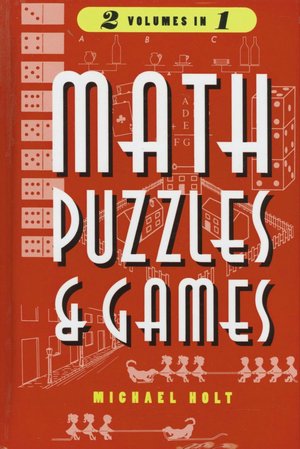
Bookshelf -- Math Puzzles & Games by Michael Holt


This is a nice little book. A good collection of puzzles concluding with an excellent set of games such as nine men's morris and tactix. It's also another example of the cheap but deserving books Barnes and Noble used to find and republish. They've shut down that division but it's still worth seeking the imprints out when you're in a used book store.

Friday, December 28, 2012

Risky Business -- board game math lessons


"Let's play Twister; let's play Risk."

No, seriously, let's play Risk, or at least talk about playing Risk. In case you're not familiar with the game, here's the Wikipedia summary
Risk is a turn-based game for two to six players. The standard version is played on a board depicting a political map of the Earth, divided into forty-two territories, which are grouped into six continents. The primary object of the game is "world domination," or "to occupy every territory on the board and in so doing, eliminate all other players."[1] Players control armies with which they attempt to capture territories from other players, with results determined by dice rolls.
(invented by the director of the Red Balloon -- who knew?)


Risk can be a good taking off point for a number of lessons and assignments like:

1. Strategic thinking -- break the class into groups, have them write up rules and recommendations for the game then test these ideas in a tournament

2. (not math but why should that stop you?) -- what modern countries and provinces correspond to the regions on the board? What are they like? You might add naming these countries as a condition for conquering a region.

3. Probability -- what are the chances of taking a country with j attackers and k defenders? What's the expected strength of j if there is a conquest, k if the attack is repulsed?

But the main lesson I'd like to suggest is an introduction to graphs. We have other graph based games and puzzles in our tool chest such as doublets and the six degrees game but Risk is probably the most familiar to the kids. More importantly, it requires actually working with graphs as part of a larger problem.

After the students are acquainted with the game, explain the basic terms of graph theory then show them something like this subgraph of North America


Ask the students to do the following (After checking to make sure I got this right) :

1. Fill in the other countries

2. Explain what's special about nodes like Alaska and Greenland

3. Draw subgraphs of each continent

4. Find the shortest path between various pairs of countries
  4b Find the shortest path between various pairs of countries when certain territories (particularly Russia) are blocked
  4c (advanced) With randomly placed armies, see which path would be easiest to conquer

5. Play a game on a node and edge board

6. Make up new node and edge boards. Give the territories real or mythical names. Try playing a few games on them.


Friday, November 23, 2012

Agon -- the classic game you've probably never heard of


I don't know exactly what happened to Agon, but I'm pretty sure those damned orthogonalists had something to do with it. The game was all the rage in Victorian England where it was appreciated for its simple rules but surprisingly complex strategies. (the Victorians were also big fans of Lewis Carroll's Doublets, thus showing remarkably good taste in diversions.) The game was and is remarkably challenging and enjoyable but early in the Twentieth Century it faded away, perhaps due to the hegemony of orthogonal game boards.

You can find a complete set of rules on my game site. You can also buy boards there but obviously waiting for delivery would undercut the whole 'here's a game for this weekend' concept so I've included two JPEGs that you can print off if you can't find a suitable substitute (lots of games use a 6x6x6 hexboard so locating one shouldn't be that difficult).


The game is extraordinarily easy to learn. Each player starts out with six pawns and a queen spread out around the edge out the board.

A piece can either move around a concentric hexagon or go toward the center. The object is to get your pieces arranged like this (black wins):

'Capturing' is done in the style of many older games by placing two of your pieces on either side of the opponent's piece. I put the word in quotes because a captured piece is not removed from the board. Instead, it is moved back to the outer ring. Agon is therefore entirely a game of position. Novice chess players have a tendency to play for points and measure how well they're doing by how many of their opponent's pieces are lined up by the side of the board. Learning Agon can help break them of some bad habits.

I first came across Agon in David Parlett's Oxford History of Board Games -- an excellent resource if you're thinking about teaching a math class and not a bad read if you just enjoy games. Parlett is also a game designer of some note so he brings a lot of insight to the discussion.

Originally posted in West Coast Stat Views

Thursday, November 15, 2012

Topologists at play -- the game of Sprouts


It's important to have students think deeply about math in both structured and unstructured ways (I have a guilty feeling that I ought to say more about this, but that will have to wait for a future post). It's the unstructured part that tends to cause problems. That's one of the reasons I liked to make games part of my lessons when I was a teacher.

Games (at least the kind I recommend) require a great deal of focus -- you have to think about what you're doing or you won't do well -- and they encourage exploration and a playful attitude to the material. All of these things help build mathematical intuition.

On the subject of topology, my game of choice is Sprouts, invented by mathematicians John Horton Conway and Michael S. Paterson at Cambridge University in 1967 (as a general rule, you can't go wrong with a game if Conway had anything to do with it).

The rules are simple:

1. Start with some dots on the paper. The more dots you have the longer the game takes so you will probably just want to start with two or three.
2. Players take turns either connecting two of the dots with lines or drawing a line that loops back and connects a dot with itself.
3. The lines can be straight or curved but they can’t cross themselves or any other lines.
4. Each dot can have at most three lines connecting it.
5. When you draw a line put a new dot in the middle.
6. The first player who can’t draw a line loses.

You can find a couple of sample games here.

Originally posted at Education and Statistics